Streaming Services Commercial Loudness
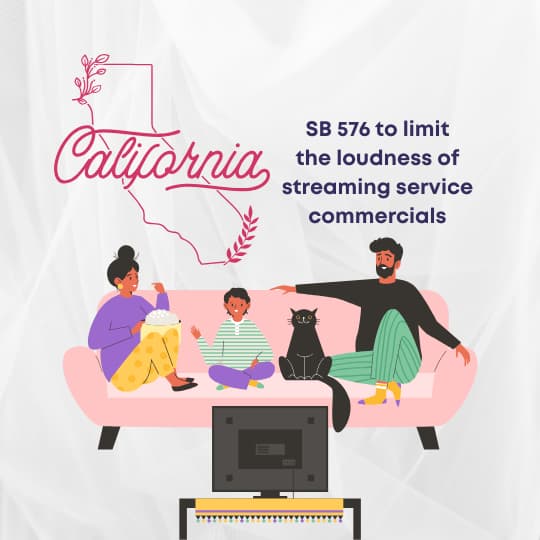
On October 7, 2025 California governor Gavin Newsom signed California SB 576 for Limiting Streaming Services Commercial Loudness. The CA SB 576 bill text was written by State Senator Thomas Umberg, who noted how commercials on streaming services were on average so much louder than program content. So much so that streaming commercials would wake up his daughter when she was trying to sleep. Umberg said, “This bill was inspired by baby Samantha and every exhausted parent who’s finally gotten a baby to sleep, only to have a blaring streaming ad undo all that hard work. He added, “SB 576 brings some much-needed peace and quiet to California households by making sure streaming ads aren’t louder than the shows we actually want to watch.”
I have to admit, my daughter loves to watch relatively quiet movies before bed. Until a commercial crashes in at -14 LUFS (YouTube Streaming Levels) instead of -23 LUFS (Broadcast TV Levels).
The CALM Act Does not Cover Streaming
Wait, Streaming and Broadcast levels are different? Wasn’t there a CALM Act in 2010 that regulated broadcast TV levels so that commercials weren’t louder than the average volume of the programs? Yes, and yes. Although Netflix launched in 2007 and Amazon started streaming in 2006, Streaming Services were not widely adopted when the bill was written in 2009. The CALM Act applies to broadcast television operators, cable operators, or other multichannel video programming distributors. It does not apply to limiting Streaming Services Commercial Loudness. Levels for the CALM Act were based on the International Telecommunications Union’s new standard for average program loudness. This standard is called LKFS, which is an acronym which stands for Loudness, K-Weighted, referenced to digital Full Scale.
Today, the industry mostly uses the European standard called LUFS which means Loudness Units, relative to digital Full Scale. LUFS uses easier notation, and takes into consideration the gate applied to a program’s volume. The European Broadcasting Union set the broadcast program standard of -23 LUFS in 2010. This is now a global standard. That standard has not applied to Streaming Service Commercials until now.
Loudness Standards for Streaming Audio: YMMV
Standards for Streaming Audio loudness are all over the place. On the one hand, Netflix recommends program mixes use conservative audio levels of -27 LKFS with peaks of -2dB True Peak. But that’s not how commercials on Netflix sound! Commercials are often mixed using dynamic compression, enhanced mid range frequencies, and often lots of low end rumble. All this to sound “in your face” even at low volume levels. Allowing a commercial mixed like that to go above -23 LUFS is going to be much more notably louder than a show. Commercials will often be mixed at louder levels when it is being created. This is in part because commercials aren’t just going to one Streaming Service. They might also be going to YouTube, Facebook, or Spotify, etc.
And here’s the fun part: all of those other streaming platforms use various LUFS standards that are well above -23 LUFS. Have a look:
- Amazon, Spotify, YouTube: -14 LUFS
- Apple: -16 LUFS
- AES: -18 LUFS for voice over and dialogue, -14 LUFS for music, -20 to -16 LUFS for radio
Where do we go from here?
The new California SB 576 for Streaming Services Commercial Loudness does not go into effect until July 1, 2026. Like the CALM Act of 2010 it does not set penalties for non-compliance. Will other states adopt this rule? And will it make things difficult for Streaming Services to comply on a state-by-state basis? Perhaps the streaming services will simply apply the new California guideline across the United States to simplify matters. In 2023, the US Senate sought to amend the CALM Act to include Streaming Services, but the proposed bill did not pass out of committee. In February 2025, the FCC approved a Notice of Proposed Rulemaking to seek public comment on the loudness of Streaming Services commercials. You can read about the FCC commercial loudness initiative here and how to submit your comments.
How will the new loudness standards influence voice overs? Let’s hope the new rules make people less adverse to watching adverts!