
AKG C114 Review: Improved Replacement for the C214 and Perception Line
When AKG announced a brand-new C-Series lineup at NAMM 2026 and its flagship AKG C114, the company was taking a chance. Over twenty years ago, AKG launched their affordable Perception series with Chinese manufacturing, and then the C214 (and C314). They were very good Chinese microphones for voiceover, but a little brittle on the top end. And nobody would confuse those mics with the venerable C414 line, which has been a studio stalwart for over 50 years. In 2026, could AKG pull off an affordable microphone that really does sound close to a C414 without a harsh top end?
The Lineage Matters
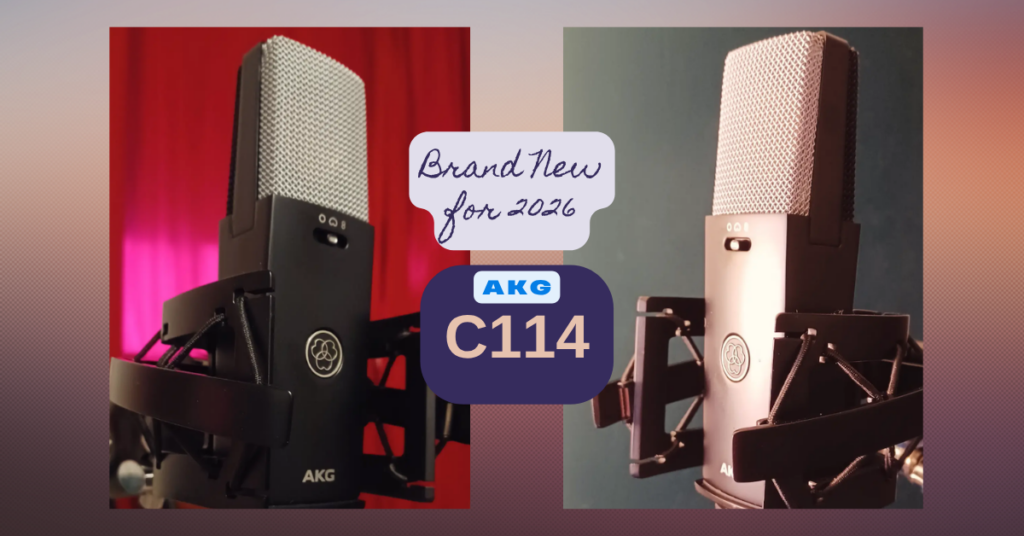
Rather than a rebranded (Perception) or repackaged design (as is the C214), the C114 is a creative updated interpretation of that C414 sound developed by AKG Product Manager Phil Feinman and his AKG engineering team. The microphone looks like an updated C414, with a simplified multipattern switch. It’s a very well made microphone, using post-industrial recycled metal. It weighs in at a beefy 415g, which is 35g less than a TLM 103.
Speaking of which, the C114 is also a transformerless microphone like the TLM 103. It has a better maximum sound pressure level (145 dB) than the TLM 103 (138 dB). However, the TLM 103 does better in the Signal to Noise Ratio category, having an 87 dB rating, while the AKG C114 is at 82 dB. However, that 82 dB rating is in good company, since it is the same as found in a U87 Ai, TLM 102, and the Sennheiser MKH 416 (81 dB).
At the heart of the AKG C114 is an edge-terminated capsule, a design found going back to AKG’s CK12 capsule. It’s a 26mm dual-diaphragm, true condenser pressure gradient capsule: gold-sputtered, edge-terminated paired with a modern, low-noise transformerless FET circuit.
Solid Construction and Reliability vs. Other Chinese Microphones
For me, the dual-diaphragm feature is the difference maker. I’ve always found this makes for a mic with a really nice top end. I’ve owned a dual diaphragm CAD E100s and a Studio Projects CS5, and while they each sadly broke down with unusably high self-noise after three years, they sounded fantastic before that. Note that the dual-diaphragm C314 sounds so much better than the scooped sound on the single diaphragm C214. If you can get a good deal on a used C314, I would highly recommend it.
Going back to my old Chinese microphones that broke down: can we trust these new C Series AKG mics, when they are made in China and are owned by the South Korean behemoth Samsung? After all, Beyerdynamic recently launched a disastrous Chinese line that they had to scrap after a year.
I would argue that we can trust these new AKG mics, because the Chinese AKG Perception mics have been solid as a rock for 26 years. Also, Chinese competitors at sE Electronics make the excellent sE 4400 and T2 multipattern microphones with similar specs that I whole-heartedly would recommend in the sub-$500 category. You can make great microphones in China. Shure’s new KSM line is Chinese. Last time I checked, they also make Apple computers that work just fine and some of the best EVs in the world.
What Voiceover Studios Actually Care About: The Sound
For voiceover work, three things matter above all else: how the voice sounds in the low mids, whether the top end is smooth or harsh, and how quiet the mic is when you’re not talking. The AKG C114 delivers on all three.
The broad midrange is spot-on, with no weird shifts in the response, and the low end is solid and not muddy at all. For voice work, that midrange neutrality means your natural vocal character comes through without the mic imposing its own personality on the read. RØDE mics can be boomy and boxy in this range requiring a lot of EQ TLC. Frankly, they’re a hot mess around 300 Hz and 700 Hz. YMMV. I don’t find the need to EQ the lows or mids very much at all on the C114. And the proximity effect is much less than on the RØDE NT1. Sometimes, you want to get close to the mic without it sounding like a cartoonish nightmare.
As for plosives, I would recommend a pop filter; but I can work the C114 slightly off axis from 6” away at a conversational volume without problems. Standard round foam pop filters fit over the top of the grille, which is handy. I would say the lows and low mids are not as present as they are in the warmer C414 variants, but closer to what you find in a TLM 103 or TLM 102. For a $229 mic, that’s a great deal.
The AKG C114 is One of the Best Sub-$500 Mics for High Frequencies
The high end is what makes this microphone truly great, whatever the price. The treble quality is beautifully smooth and detailed with no harshness. Harshness in the top end is the enemy of long voice over sessions: it causes ear fatigue for engineers and sounds unpleasant after hours of editing. The C114 avoids this. The top end sounds like a brighter C414 XLS, but it’s smooth and not sibilant. I experimented with adding to the C114 a lot of 5 kHz and above EQ, Exciters, and rugged compression, and the highs still sounded great.
At the end of this review there are two links from other sites with examples of the C114 raw audio without processing. But here, you can hear what it sounds like with full processing in a mix. It has EQ, LA-2A Style Compression, an Exciter, and a Master Compressor. The highs still hold together in this 44.1 kHz 16-bit stereo .wav file:
The AKG C114 is a high-quality microphone in how it makes the voice sound better right out of the box, with no EQ or compression. Hearing nuance and tonal variation while tracking makes it easier to perform with emotion. For voice actors, such immediate confidence in monitoring is invaluable. With the C114, you don’t have to check yourself on harsh metallic sibilants that you get with the AKG C214, RØDE Mics, or even the TLM 103. Just power up the preamp and let it rip.
Multi-Pattern Versatility: More Useful Than You Might Think
The C114 offers cardioid, omnidirectional, and figure-of-eight polar patterns, selectable via a front-panel switch. For a dedicated home VO booth, you may use only the cardioid pattern, but the additional patterns open possibilities. Studios doing telephonic ADR or two-person narration sessions will appreciate the figure-of-eight mode for facing two voices across a single mic. The omni pattern is useful for capturing natural room ambience for documentary or theatrical work, or for situations where a more open, three-dimensional sound is needed. This kind of flexibility in a mic, that actually sounds really good, under $500 is rare.
For me, the figure of eight pattern on the C114 has more of a low-end roll off and greater high-end boost. I don’t record in a booth but in a large room treated with acoustic panels and bass traps. So, with the right mic placement, the figure of eight pattern sounds best for some reads. Go figure!
The pattern mic switch makes a little bit of noise for just a half second as is the case with almost all Chinese multipattern mics. But best practices would have you switch patterns with the phantom power off, or the mic muted, right?
It’s a Darn Good Lookin’ Mic
Voiceover studios are increasingly video-forward with client patch-ins, YouTube content, and Zoom (and Teams…yuck). With a refreshed, modern aesthetic that honors AKG’s classic slim and boxy look, the AKG C114 not only sounds outstanding but also makes a striking visual impression on camera, and the low-profile shock mount looks like it’s part of the mic in a seamless aesthetic. Just say no to clunky spiderweb shock mounts!
The included H84 shock mount is custom-designed and screws directly into the mic body for a clean, elegant solution. The shock mount works great and looks great. Plus, it accepts small and large stand screws, so no more pesky adapters!
And yes, the microphone body is crafted from 100% recycled PIR metals and alloys, with packaging and accessories engineered for minimal environmental impact. If your studio has sustainability commitments, this is a guilt-free mic (other than having it shipped from China, of course). Getting a mic shipped in a simple sturdy white box might feel weird, like you’re just buying an iPhone. But it’s all recycled, including that what seems like plastic wrapping is really recycled wax.
The Verdict for the AKG C114
While the C114 is not a C414 replacement, it does sound maybe 90% like a C414 XLS specifically. Check out this AKG mic shootout here in a studio with voice, drums, and guitar. Also, there is an interesting mic shootout at Gearspace between the C114 and four vintage C414 models used on spoken word. Some people responded that the C114 was their favorite. Others, that it was in the middle of the C414 pack. Nobody said it wasn’t as good. For a fifth of the price, you’re getting at least 75% of the sound quality. And it might be better for some voices, if you’re looking for something with a brighter, fresher sound.
For voiceover actors building or upgrading a home studio, this mic belongs on your short list. In addition, for voice over studios looking for a high-performing backup or second-booth mic that won’t require laying out as much cash, the C114 makes an easy case for itself. For podcasting, the C114 or even the electret cardioid-only C104 is a great choice and looks great too.
At $229, with this level of quality in sound and build, it’s one of the best buys in voiceover right now. It just sounds great.
AKG C114 — Quick Specs for Voiceover
- Capsule: 26mm gold-sputtered dual-diaphragm, edge-terminated
- Polar Patterns: Cardioid / Omni / Figure-8
- Frequency Response: 20Hz – 20kHz
- Self-Noise: 12 dB(A)
- Max SPL: 145 dB
- Includes: H84 shock mount
- Street Price: $229
Available at Sweetwater (where you make a friend for life with your sales rep whether you want to or not), B&H, American Musical Supply, and directly from AKG.
Have you tried the AKG C114 in your booth? Drop your experience in the comments. I’d love to hear how it performs on different voice types.