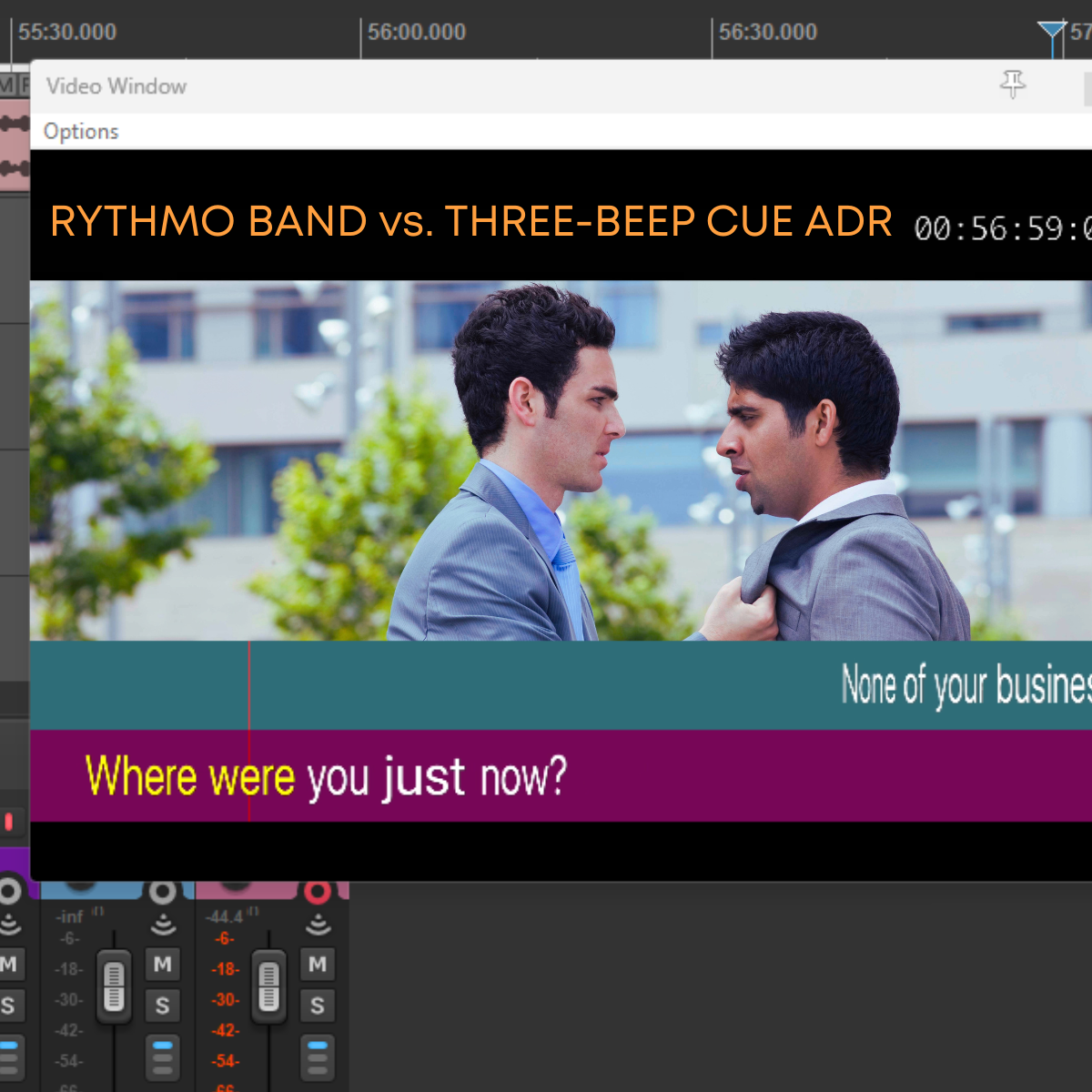
Rythmo Band ADR vs. Three-Beep Cue
The Rythmo Band ADR and the traditional Three-Beep Cue method are the two primary ways dialogue is dubbed or replaced in post-production ADR (Automated Dialog Replacement). While Rythmo Band relies on continuous on-screen text flow, Three-Beep Cue relies on an audio trigger. Both Rythmo Band ADR and Three-Beep Cue offer their own advantages for actors and engineers.
Here is how they compare directly:
| Feature | Rythmo Band | Three-Beep Cue (Traditional ADR) |
|---|---|---|
| Primary Trigger | Visual scrolling text passing a fixed vertical target line. | Three auditory beeps to start, then the actor speaks on the silent fourth beep. As in “One, two, three, go!” |
| Actor Focus | Strictly on the screen. The Rythmo Band script scrolls directly below the video, keeping the actor’s head up. | Split focus. The actor must look down at a paper or tablet script, then up at the screen. |
| Lip-Sync Precision | Extremely high. Text is physically stretched or compressed to match the exact duration of the mouth movements. Easier to do full scenes. | Moderate to high. Relies heavily on the actor’s memory, internal rhythm, and multiple takes to nail the timing. Harder to do full scenes. |
| Microphone Consistency | Excellent. Because actors don’t look down at paper, their head position and distance from the mic stay perfectly uniform. | Variable. Looking down at a script can cause off-axis microphone coloring. And watch out for rustling paper and desk noises! |
| Session Speed | Fast (once prepared). Actors can seamlessly flow from line to line without stopping, often recording 20–25 lines per hour with Rythmo Band. | Slower. Every short segment requires a loop: watch/listen, hear the beeps, record, reset. |
| Preparation Time | High prep time. A specialized “rythmo band writer” must meticulously map out and stretch the text. | Low prep time. Production just needs standard cue sheets with timecodes and script printouts. |
Summary of the Workflow Difference
In a Three-Beep Cue session, the actor hears beep… beep… beep… and must perfectly time the start of their line, mimicking the performance they see on screen. It requires the actor to memorize the rhythm of the original line in short bursts. Meanwhile, Rythmo Band ADR allows actors to read naturally with less stress about timing.
In a Rythmo Band ADR session, the actor reads the dialogue like a specialized teleprompter. Because the text expands and shrinks dynamically to show exactly how long to hold a vowel or when to pause, the actor can focus entirely on acting and emotional delivery rather than mechanical timing.
For me, I love this since for years I ran teleprompters as part of my job in the AV department at Cramer Productions. However, an actor who is not well prepared with the script and/or does not have experience with Rythmo Band or teleprompters will sound like they are doing a clunky cold read with Rythmo Band. Some engineers call it Karaoke Voiceover, and in worst-case scenarios, it does sound like that. But like any tool, the skilled make it work to their advantage.
To get a basic idea of what a Rythmo Band looks like and works, check out this video for installing a free Rythmo Band system for REAPER (in French with subtitles “Bande Rythmo pour le Doublage”, how meta!)
History of Rythmo Band and Three-Beep Cue Dubbing
The Three-Beep Cue became the standard in Hollywood and is used most widely in English speaking countries such as the US and UK. Rythmo Band “Bande Rythmo” was developed in France in the early 20th century (as an additional hand-printed band on film!) and was used in France, Quebec, and other francophone countries, but its popularity has spread throughout Europe. But then in 2003, KIWA Digital from Auckland, New Zealand came up with a digital Rythmo Band in order to dub children’s shows into te reo Maori!
Of course, this new digital version of the Rythmo Band ADR was quickly adapted by Francophone studios. I have dubbed documentaries, video games, and international action films with French producers using Rythmo Band and I love it. It’s great for live-directed sessions, but if you know your DAW well, it’s easy to use in self-directed sessions as I have done on many projects. Thanks to Rythmo Band ADR, these dubbing projects were both efficient and precise.
Rythmo Band ADR Software Companies
The biggest Rythmo Band software company is VoiceQ, which is the global industry leader. Developed by KIWA Digital, it offers VoiceQ Writer (for translators/adapters) and VoiceQ Pro (for recording studios). It provides a fully digital Rythmo Band interface, auto-syncs text, features character filtering, and integrates directly with Digital Audio Workstations (DAWs) like Avid Pro Tools and Apple Logic Pro.
Other software comes from newer companies like Voxdub which has a lower price point and is geared towards smaller studios, schools, and voice actors. It works in browsers or desktop apps with full Rythmo band manipulation, loop segmentation, and AI tools. As Rythmo Band ADR continues to develop, more studios around the world are adopting this technology for their dubbing needs.
Rythmo Band ADR for the Voice Actor
I’ve also had the pleasure of working with TransPerfect’s StudioNext on documentaries. It’s a great tool for translation and localization because it has its own basic DAW built in which teams can access. So, the voice actor can record independently in an area below the rythmo band, and the translation team/ producers can instantly edit/approve the files and work with them on the final mix. Very convenient! The voice actor can also make basic edits to the recordings to make sure they match up before marking them as submitted for approval.
Whether you prefer Rythmo Band/Bande Rythmo ADR or Three-Beep Cue ADR, it’s good to know both. To be fair, here is a fascinating message board discussion from 2010 by audio engineers talking about how to manage ADR sessions with both dubbing techniques, and how to get voice actors to work well with either of them. A long time ago I used to say “I never punch and roll for voiceover” but that was for standard non-dramatic narration. For documentaries, tv, films, and videogames, let’s (punch and) roll!