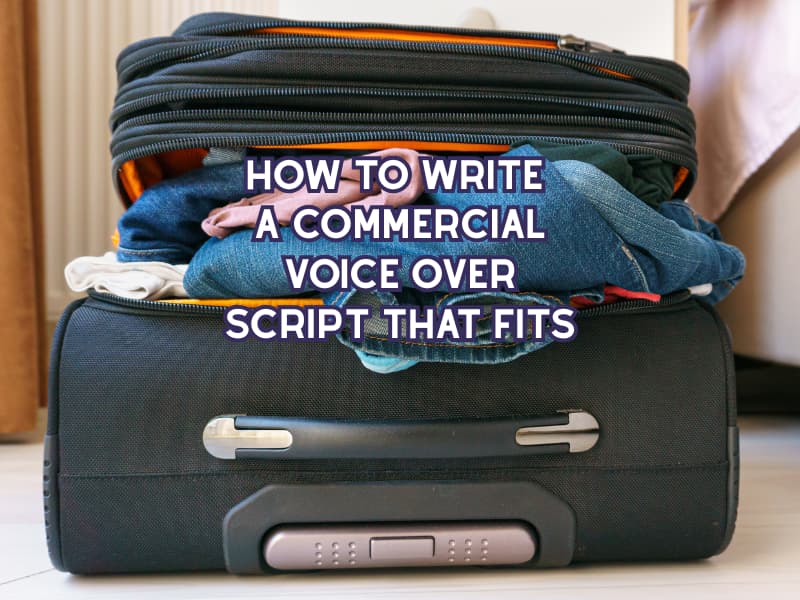
How to Write Commercial Voice Over Scripts That Fit
Word Count vs. Voice Over Pacing
You’ve spent weeks refining your brand’s messaging. Every adjective is punchy, the value proposition is airtight, and the closing and CTA nail it. You copy-paste it into a document, look at the block of text, and think, “Perfect. This is our next 30-second commercial voice over script.” Eventually, you hand it off to your voice actor, and the trouble begins. Either the talent has to read the copy at a hypersonic, auctioneer pace just to hit the timings, or your video editor has to aggressively chop out critical pauses, leaving the final mix feeling cramped and frantic. Neither option sells a product.
You would think anyone who finished basic education levels would know this already. But immediately after writing the first draft of this post, I turned on the Yankees vs. Red Sox game here in Atlanta on national broadcast. There was a new ad for a dog food brand. I’m not sure what the name was because the spot was wall-to-wall voiceover, and the last two lines were so fast to make it fit that neither my wife nor I knew what they were really saying. And the voice went right up to the :30 stop and may have been slightly clipped on the last word. Not ideal, especially for a new brand.
When it comes to commercial voice-overs, word count is helpful; while pacing is what drives success. Here is how to write a commercial voice over script that respects the clock and gives your message room to breathe.
Mouth Math
Let’s look at the baseline physics of speech. In a standard, conversational commercial voice over script read that sounds like a helpful peer rather than a panicking salesman, the average human speaks at a rate of roughly 2 to 2.5 words per second. When you apply that math to standard ad lengths, the limits become clear very quickly:
| Ad Length | Safe Word Count Range | The Dynamic |
| :15 Spot | 30 – 35 words | High impact, single message, instant hook. |
| :30 Spot | 60 – 85 words | The sweet spot for a standard narrative arc. |
| :60 Spot | 120 – 150 words | Room for a problem, solution, features, and deep CTA. You’re pushing your luck with more than 150 words and asking the audience to listen to a lot of yapping. You have sixty seconds. Show don’t tell. |
If your 30-second script has 95 words in it, you aren’t leaving room for a commercial performance. You are asking for a speed-read. For making precise calculations for the length of your commercial voice over script, check out my Voice Over Script Timer Calculator.
Leaving Room to Breathe
A great commercial isn’t a continuous wall of sound. The magic of a persuasive voice-over happens in the quiet spaces between the phrases.
When you overstuff a script, you force the voice actor/editor to sacrifice three critical production elements:
- The Emotional Beat: If the voice actor delivers a poignant line about a frustrating problem, the audience needs a split second to feel that frustration before you swoop in with the solution.
- Sound Effects and Music Visuals: If your video features a sharp visual transition, an on-screen text pop, or a specific sound effect (like a product snapping open or a car braking), the audio track needs to yield to that moment.
- The Call to Action (CTA): Say that the website URL or promo code at the end of your spot is the most important part of the script. If the talent has to blast through “Visit-our-website-at-brand-name-dot-com-terms-and-conditions-apply” in two seconds, no one will remember it. In a lot of :60 SLRs I do, the script says the URL thrice in the CTA. Seems like overkill, but it isn’t.
The “Read Aloud” Stress Test
Before you send your final draft to a voice actor or casting director, put your script through this quick, three-step confidence check:
1. Read it out loud with a stopwatch
Don’t read it in your head, and don’t mumble it. Stand up, open your mouth, and read it at a natural, relaxed, conversational pace. Force yourself to read it slower. Perhaps drag your finger under the words as you read.
2. Add a 3-second penalty buffer
If you timed your reading perfectly at 29 seconds, your script is still too long. In a real production, you need a second at the beginning for the video to establish, time for transitions, and a clean tail at the end so the audio doesn’t cut off abruptly. Aim for your read to naturally land around 26 or 27 seconds, because realistically it has to be at least 28.5 seconds for broadcast. I see a lot of local/regional ads get cut off prematurely here in Atlanta (a major market, right?) and it drives me bonkers. Assume that the final product has no room for a voiceover longer than 27 seconds.
3. Simplify the tongue-twisters
Look for back-to-back words with heavy consonant clashes (e.g., “specifically strategic statistics”). If it’s hard to say, it will kill the momentum of the spot. Swap them out for smoother, cleaner synonyms. Speaking of which, check out my Tongue-Twister Tips for Voiceover which addresses the pitfalls inherent in the English language.
The Bottom Line
A lean script gives a professional voice actor the freedom to play with inflection, emphasize your key branding terms, and deliver a tone that actually connects with your target audience. Write less, pace intentionally, and let the space do the selling.
Need a conversational, perfectly timed delivery for your next broadcast or digital campaign?
Head over to my Commercial Voice Over Services to listen to my latest reels, check out my studio specs, or drop a copy of your script via the contact page for a free, custom time-test audition.